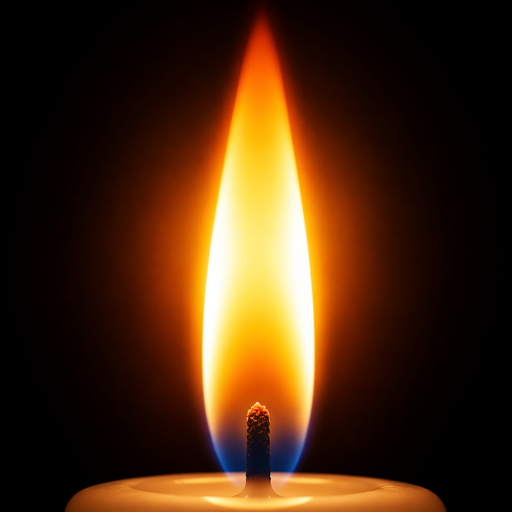
 Tomoshibi
Quick answer: Fire-safety agencies consistently report that candles are a leading cause of home fires, that a large share of candle fires start in bedrooms, and that falling asleep with a candle burning is a factor in a significant portion of candle-fire deaths — which is why every standard safety rule (never leave one unattended, never sleep with one lit, keep 30 cm of clearance) requires you to stay alert. Burning candles also produce soot that stains walls and fabrics and, if scented, fragrance compounds some people find irritating, and open flames are simply prohibited in most dorms, hotels, hospitals, offices, and aircraft. A flameless candle is therefore the better tool for a specific set of moments — falling asleep, homes with small children or pets, places where fire is banned, nightly rituals, and sensitive air — while real candles stay lovely for supervised, wakeful occasions.
Let’s start with the honest part: nothing fully replaces a real candle. The scent of warm wax, the faint heat, the tiny hiss when you light the wick — real fire has a presence that pixels and LEDs can only approximate. But real fire also has properties we tend to forget until they matter: it spreads, it smokes, and it does not care whether you fell asleep. This guide is about choosing the right kind of flame for the moment — because there are situations where the beautiful choice and the wise choice are not the same.
How dangerous are real candles?
Fire-safety agencies in nearly every country tell a consistent story: candles are a leading cause of home fires, and the pattern behind those fires is depressingly repetitive. Fire services consistently report that a large share of candle fires start in bedrooms, and that falling asleep with a candle burning is a factor in a significant portion of candle-fire deaths. The classic scenario is exactly the cozy one: a candle on the nightstand, a relaxing evening, drifting off — and a flame left alone with curtains, bedding, or a paperback within reach.
Standard candle-safety rules exist for good reason, and they are worth restating plainly:
- Never leave a burning candle unattended, even “just for a minute.”
- Never fall asleep with a candle burning — this is the single most dangerous candle habit.
- Keep at least 30 cm (a foot) of clearance from anything flammable: curtains, bedding, paper, decorations.
- Use a stable holder on a heat-resistant surface, away from drafts, children, and pets.
- Extinguish before the wax pool reaches the container’s edge, and don’t burn a candle to its very bottom.
Notice what these rules have in common: they all require you to stay alert. A real candle is a commitment to supervision — which is precisely what you don’t want from the thing that is supposed to help you unwind.
What about soot, smoke, and scent?
Beyond fire risk, burning candles produce combustion by-products. A flickering, drafty flame produces visible soot that gradually stains walls, ceilings, and fabrics; scented candles add fragrance compounds to indoor air that some people find irritating. None of this makes an occasional candle dangerous for most people — but it is a real consideration for small bedrooms with closed windows, for households with asthma or scent sensitivity, and for anyone burning candles nightly rather than occasionally.
Where are real flames not allowed?
Then there are the places where the decision is made for you. Open flames are prohibited in most university dorms, the vast majority of hotel rooms and rentals, hospitals and care facilities, offices, and aircraft. If your candle ritual — an evening wind-down, a nightly memorial, a meditation practice — matters to you, it needs a form that can travel to all the places your life actually happens.
When does a flameless candle win?
Put together, a flameless candle — an LED candle or a well-made virtual candle on a screen — is the better tool in a specific, common set of moments:
- Falling asleep. The whole point of a bedtime flame is to be there as you drift off — the exact thing you must never do with real fire. A virtual candle can even turn itself off after you’re asleep.
- Homes with small children or pets. Cats and candles are a famously bad combination; toddlers and flames are worse.
- Dorms, hotels, hospitals, flights. Where the rules say no fire, pixels are the only flame you can bring.
- Nightly rituals. A remembrance candle or wind-down ritual repeated every single night multiplies both the fire-risk exposure and the soot of a real candle. Fire is lovely for occasions; software is safer for routines.
- Sensitive air. No combustion means no smoke, no soot, no fragrance load.
The traditional objection to LED candles is that they look fake — a plastic shell with a stuttering orange diode. That criticism is fair, and it is exactly where modern virtual candles have changed the calculus: a flame simulated live on a phone’s GPU can flicker irregularly, respond to movement, and glow with the layered color of real combustion, rather than looping the same three-second video.
Do you have to choose one or the other?
This isn’t an argument to throw away your candles. A reasonable pattern for most people: real candles for supervised, wakeful occasions — dinners, baths, gatherings — and a flameless flame for everything unsupervised, sleepy, nightly, or travel-bound. You keep the beauty; you subtract the risk from the moments where risk concentrates.
How Tomoshibi helps
Tomoshibi is built to be the flame you can fall asleep to. The candle is rendered live by a GPU shader, so it flickers and leans like the real thing (tilt your phone and watch it respond), while the sleep timer gradually dims the screen and puts the flame out on its own. A true black background and automatic battery saver make overnight burning practical, it works offline on flights and in dorms, and there are no ads to shatter the mood. Light it with a tap; blow it out with a tap; nothing in your room ever gets hot.