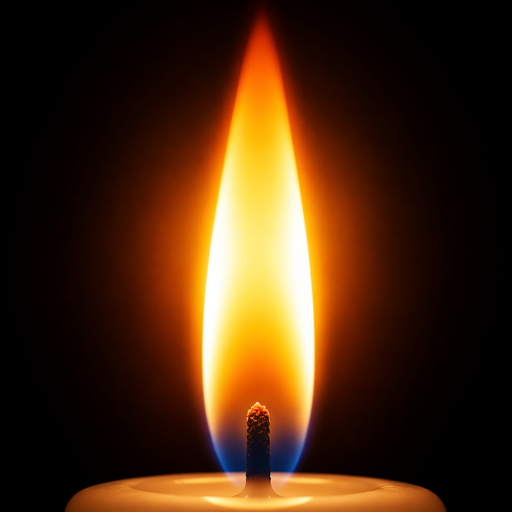
 Tomoshibi
Quick answer: Light is a signal as much as illumination: bright, blue-rich light reads as midday and alertness, while warm dim light — sunset, embers, candlelight — reads as the day ending, which is why sleep guidance so consistently recommends dimming lights in the last hour or two before bed. Candlelight also gives a room a centre, editing a space full of visible obligations down to one gentle moving point that holds attention loosely without stimulating it. The practical form is a ritual rather than a resolution: at a fixed time, dim the main lights, light the candle, and do one quiet thing in its glow for fifteen to thirty minutes — and if you regularly struggle to sleep despite a consistent low-light evening, that is worth discussing with a qualified professional rather than another app.
For most of human history, evenings were dim. When the sun set, the brightest thing most people saw until morning was fire — a hearth, an oil lamp, a candle. Our evenings today are lit like noon: ceiling LEDs, television glow, and the small bright rectangle we hold twenty centimeters from our faces until the moment we try to sleep. If your nights feel wired when you want them to feel soft, the light you marinate in after sunset is one of the most fixable reasons why.
How does evening light affect your body?
Light is not just illumination; it is a signal. Brightness and color temperature tell your body what time it feels like, independent of what the clock says. Bright, blue-rich light — the daylight spectrum that screens and cool-white bulbs imitate — reads as “midday: be alert.” Warm, dim light — sunset, embers, candlelight — reads as “the day is ending.” This is why sleep guidance so consistently recommends dimming lights in the last hour or two before bed: you are not just making the room prettier, you are changing the message your evening sends.
Candlelight sits at the extreme warm, dim end of that spectrum — roughly the warmth of the last minutes of sunset, at a brightness hundreds of times lower than office lighting. As an evening signal, it is about as unambiguous as light gets.
Why does a single point of light feel calming?
There is a second, less discussed reason candlelit evenings feel different: a candle gives the room a center. Overhead lighting flattens a space into uniform visibility — everything equally lit, everything equally demanding. A single warm point of light does the opposite. It creates a small circle of attention and lets everything outside it recede. People instinctively gather around fires and candles for this reason; the light itself edits the world down to something small and manageable.
That editing is precisely what a wound-up mind needs at night. Instead of a bedroom full of visible obligations — the laundry, the desk, the phone — you get one gentle, moving point to rest your eyes on. The flame’s soft flicker is engaging enough to hold attention loosely, but far too simple to stimulate it. Compare that to a feed, which is engineered to do the opposite: every swipe delivers something new, and your attention never gets to land.
Why does a ritual beat willpower?
Most people don’t fail to wind down because they lack information; they fail because “wind down” is vague, and vague intentions lose to specific habits like checking one more thing. The fix is to make the wind-down concrete — a short, repeatable sequence with a clear first action. Lighting a candle is an almost perfect first action:
- It is instant. One gesture, and the evening has officially changed phase.
- It is sensory. The light changes, and with a crackle or rain sound, the room’s soundtrack changes too. Your senses register the transition even when your mind is still busy.
- It has a natural end. Candles burn down; timers run out. A wind-down with a built-in ending doesn’t require a second decision to stop.
A simple ritual to try: at a fixed time, dim or switch off the main lights, light your candle, and do one quiet thing in its glow — stretch, read a paper book, write tomorrow’s list, sit with a warm drink, or practice a few minutes of candle gazing. Fifteen to thirty minutes is enough. The specific activity matters less than the consistency of the sequence: same trigger, same light, same ending.
Isn’t a candle app self-defeating?
Here is the obvious objection: if bright screens are the problem, isn’t a candle app self-defeating? It depends entirely on what the screen shows. A phone displaying a white webpage at full brightness is a small floodlight. The same phone showing a single warm flame on a true black background, dimmed low, emits a fraction of that light — on an OLED display, black pixels are literally off, so the screen produces little beyond the flame itself. The device stops being a portal to everything and becomes one small, warm object in the room.
The practical rules for screen-as-candle: turn the room lights down so the flame is the brightest thing you see; lower the screen brightness; silence notifications or use a focus mode; and give the session an end point with a timer rather than an open-ended “until I feel sleepy.”
What can a candlelit wind-down realistically do?
A candlelit wind-down is a way to make evenings calmer and more deliberate — it is not a cure for sleep problems. If you regularly struggle to sleep despite a consistent, low-light evening routine, that is worth discussing with a qualified professional rather than another app or gadget.
How Tomoshibi helps
Tomoshibi was designed around exactly this ritual. The candle burns on a true black background — on OLED screens the rest of the display is genuinely off — and the sleep timer gradually dims your screen before extinguishing the flame on its own, so the evening ends without a decision. Pair the flame with fire crackle (free) or layer rain, ocean, and singing bowls with Premium, and the app remembers your exact setup so tomorrow’s ritual starts with a single tap. No ads and no accounts means nothing pulls you back into the feed you just left.