 Trigonify
How to memorize the unit circle (without 48 flashcards)
Quick answer: The unit circle contains almost no independent information: for any angle θ measured counterclockwise from the positive x-axis, the point you land on has coordinates (x, y) = (cos θ, sin θ), and tangent is the slope y/x. Three patterns generate everything else — the √n/2 ladder, where quadrant-I sine runs √0/2, √1/2, √2/2, √3/2, √4/2 across 0°, 30°, 45°, 60°, 90° and cosine is the same ladder backwards; reference angles, since any angle’s value equals plus or minus that function of the acute angle it makes with the x-axis; and the quadrant signs summarised by ASTC. Add two radian anchors — 180° = π, and counting in sixths — and you can rebuild the whole circle in about thirty seconds instead of memorising 48 separate facts.
The unit circle looks like a memorization nightmare: 16 special angles, each with a sine, a cosine, and usually a tangent — call it 48 facts, in two notations (degrees and radians), with signs that flip depending on where you are. Students who try to brute-force it with flashcards usually get about a week of retention before it evaporates.
Here's the good news: the unit circle contains almost no independent information. There are exactly three values to learn and three patterns that generate everything else. Learn those and you can rebuild the entire circle from scratch in under thirty seconds — which is also the only version of "memorized" that survives test-day nerves.
What is the unit circle actually saying?
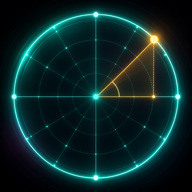
The unit circle is a circle of radius 1 centered at the origin. Take any angle θ measured counterclockwise from the positive x-axis, walk out to the circle along that direction, and look at the coordinates of the point where you land:
(x, y) = (cos θ, sin θ)
That's the entire definition. Cosine is the x-coordinate, sine is the y-coordinate, and tangent is the slope of the ray, y/x. Every fact you're about to "memorize" is just a coordinate of a point on this circle. Keeping that picture in your head is what makes the patterns below feel obvious instead of arbitrary.
Pattern 1: the √n/2 ladder
In the first quadrant there are five angles to know: 0°, 30°, 45°, 60°, and 90° (0, π/6, π/4, π/3, π/2). Here is the sine of each, written in a deliberately strange way:
| θ | 0° | 30° | 45° | 60° | 90° |
|---|---|---|---|---|---|
| sin θ | √0/2 | √1/2 | √2/2 | √3/2 | √4/2 |
Simplify and you get the familiar 0, 1/2, √2/2, √3/2, 1 — but written as a ladder, the numerators just count up: √0, √1, √2, √3, √4, all over 2. Cosine is the same ladder run backwards (√4/2 down to √0/2), because cosine at θ equals sine at 90° − θ. Two sequences, one pattern, ten values done.
Tangent comes free: it's sine over cosine. At 45° they're equal, so tan 45° = 1. At 30° you get (1/2)/(√3/2) = 1/√3 = √3/3, and at 60° the reciprocal, √3. At 90° cosine is 0, so tangent is undefined — that's where the graph of tangent has its asymptote.
Pattern 2: reference angles
Every angle on the circle has a reference angle: the acute angle it makes with the x-axis. 150°, 210°, and 330° all have reference angle 30°. And the magic fact is: a trig function of any angle equals plus-or-minus that function of its reference angle. The size of sin 150° is the size of sin 30° — only the sign can differ.
So the second and third and fourth quadrants add zero new numbers. Once you can find a reference angle — subtract from 180°, subtract 180°, or subtract from 360°, depending on quadrant — you already know every value on the circle up to sign.
Pattern 3: quadrant signs (ASTC)
The signs follow from the coordinates. In quadrant I both x and y are positive, so everything is positive. In quadrant II x goes negative, so cosine (and tangent) go negative while sine stays positive. In quadrant III both coordinates are negative, so sine and cosine are negative but tangent — a negative over a negative — is positive. In quadrant IV only cosine is positive.
The classic mnemonic is ASTC — "All Students Take Calculus" — All, Sine, Tangent, Cosine, naming which functions are positive in quadrants I through IV. Mnemonics are fine, but notice you don't strictly need one: if you can picture roughly where the point sits, the signs of its coordinates are visible.
How do you handle radians without memorising them?
Most unit-circle pain is actually radian pain. Two anchors fix it. First, 180° = π. Everything else is a fraction of that: 30° is a sixth of it (π/6), 45° an eighth of a full circle (π/4), 60° a third of π (π/3), 90° half of π (π/2). Second, count in steps: the multiples of π/6 go 1, 2, 3, 4, 5, 6 sixths around the top half — π/6, π/3 (= 2π/6), π/2 (= 3π/6), 2π/3, 5π/6, π. If you can count to six, you can label the circle.
How do you rebuild the unit circle in 30 seconds?
- Draw axes and a circle. Mark (1, 0), (0, 1), (−1, 0), (0, −1) — those are your 0°, 90°, 180°, 270°.
- In quadrant I, write the sine ladder √1/2, √2/2, √3/2 going up; cosine is the same ladder going down.
- For any other angle: find its reference angle, copy the quadrant-I value, apply the ASTC sign.
Run that drill once a day for a week — paper, whiteboard, or a fogged mirror — and the circle stops being a memory task at all. It becomes a thing you generate, which is precisely the skill that transfers to graphing, identities, and solving equations later in the course.
How Trigonify helps
Trigonify's home screen is a draggable unit circle: as you move the point, sine, cosine, and tangent update live, and it snaps to the special angles with exact values — √3/2 and π/6, not just 0.866 and 0.524. A reference-triangle overlay shows the quadrant and reference angle for whatever you're pointing at, and practice drills with streaks and a mistake log turn the rebuild drill above into a daily habit. It all runs offline on iPhone and Android with no account and no ads. See everything Trigonify does.