
A pocket encyclopedia for iPhone and iPad
Meet the 150+ historical figures who shaped twelve centuries of civilization
From the scholars of Baghdad's House of Wisdom to the poets of Al-Andalus, from Ottoman sultans to Mughal emperors — Legata is a beautifully designed reference atlas built for calm, focused reading. No ads. No feed. No chatbot.
Free to start — explore your first three figures with no account and no commitment.
A look inside the atlas
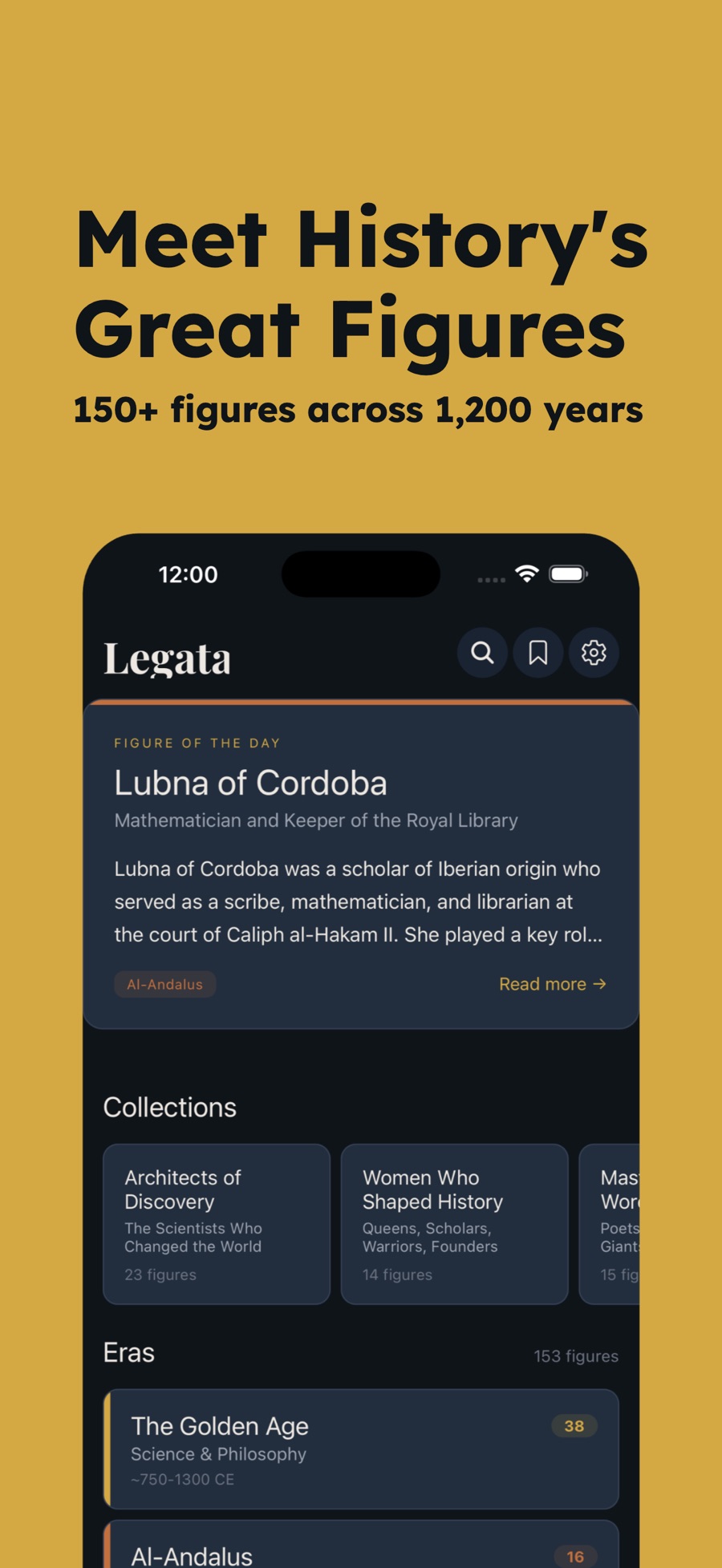
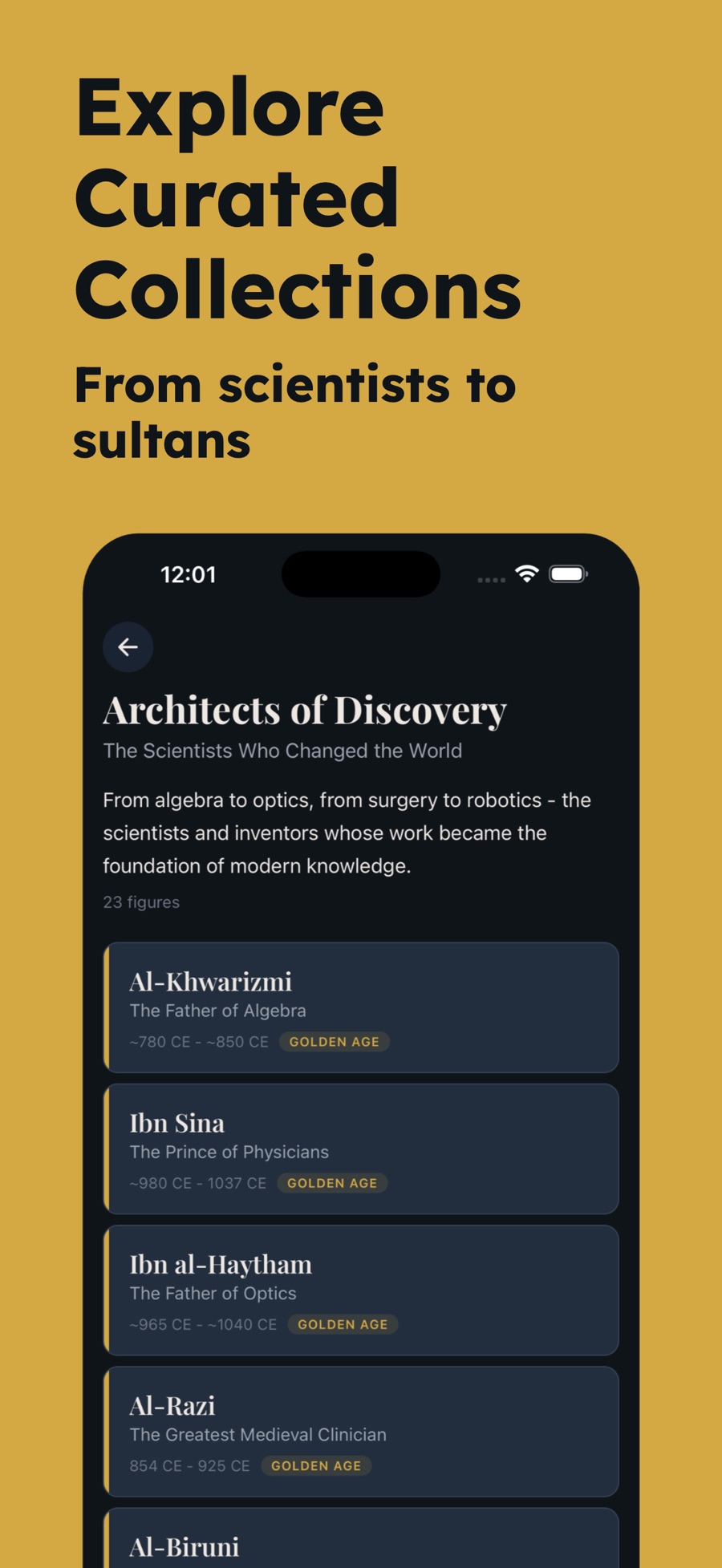
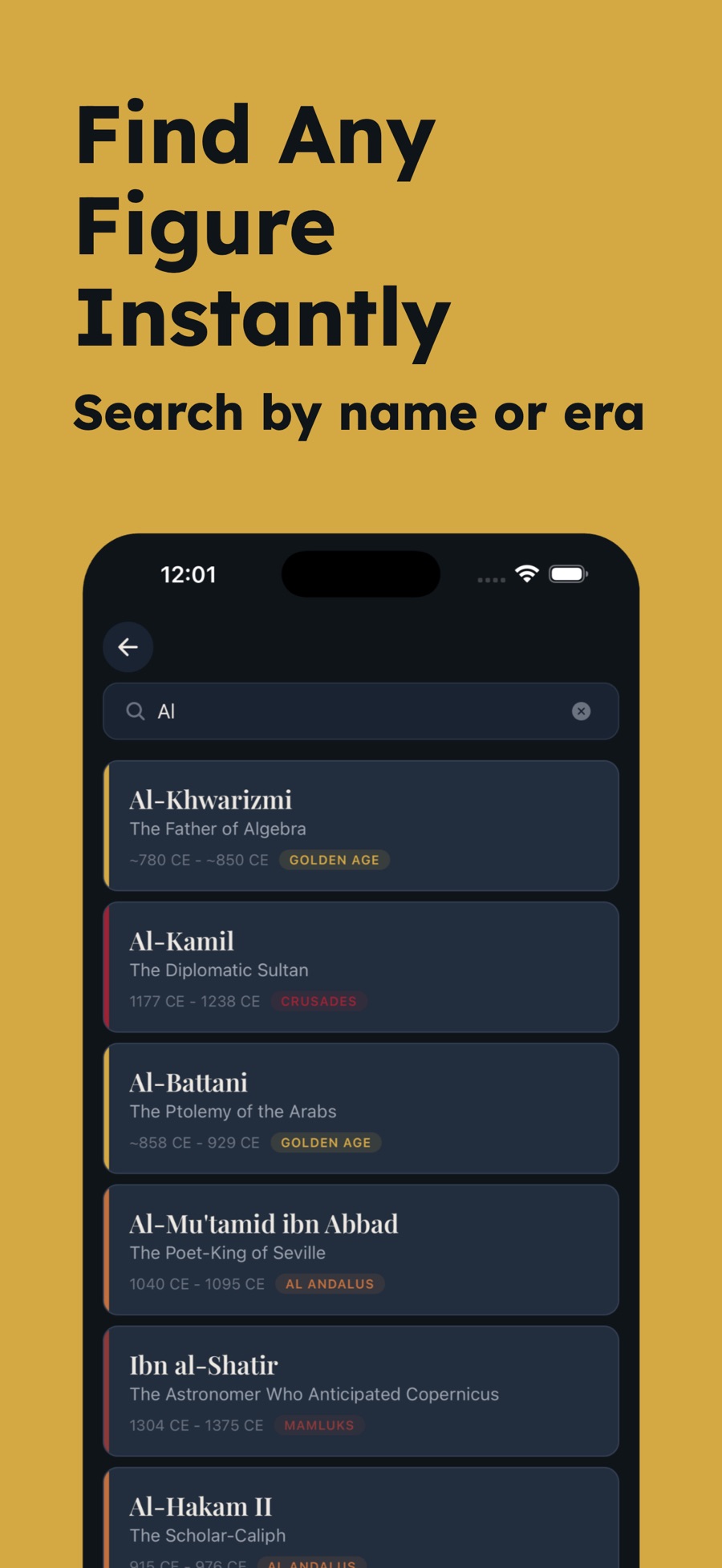
Screens from the app itself — the daily figure and era index, a curated collection, and alias-aware search.
Great lives deserve better than scattered tabs
The problem
Try reading about Ibn Sina, Saladin, or Mansa Musa online and you end up bouncing between ad-heavy pages, half-sourced summaries, and quiz apps that gamify names without context. The connections that make history meaningful — who taught whom, which cities shaped which minds — get lost.
The Legata approach
Legata gathers 150+ meticulously researched figures into one quiet, well-typeset atlas. Every biography carries academic source citations. Relationship-first navigation reveals teacher–student, family, patron, and contemporary links, so you can follow the Silk Road of ideas from Central Asia to Andalusia.
What you will find inside
Everything below comes straight from the atlas itself — scientists, philosophers, military leaders, poets, mystics, architects, and reformers across three continents.
Researched figures
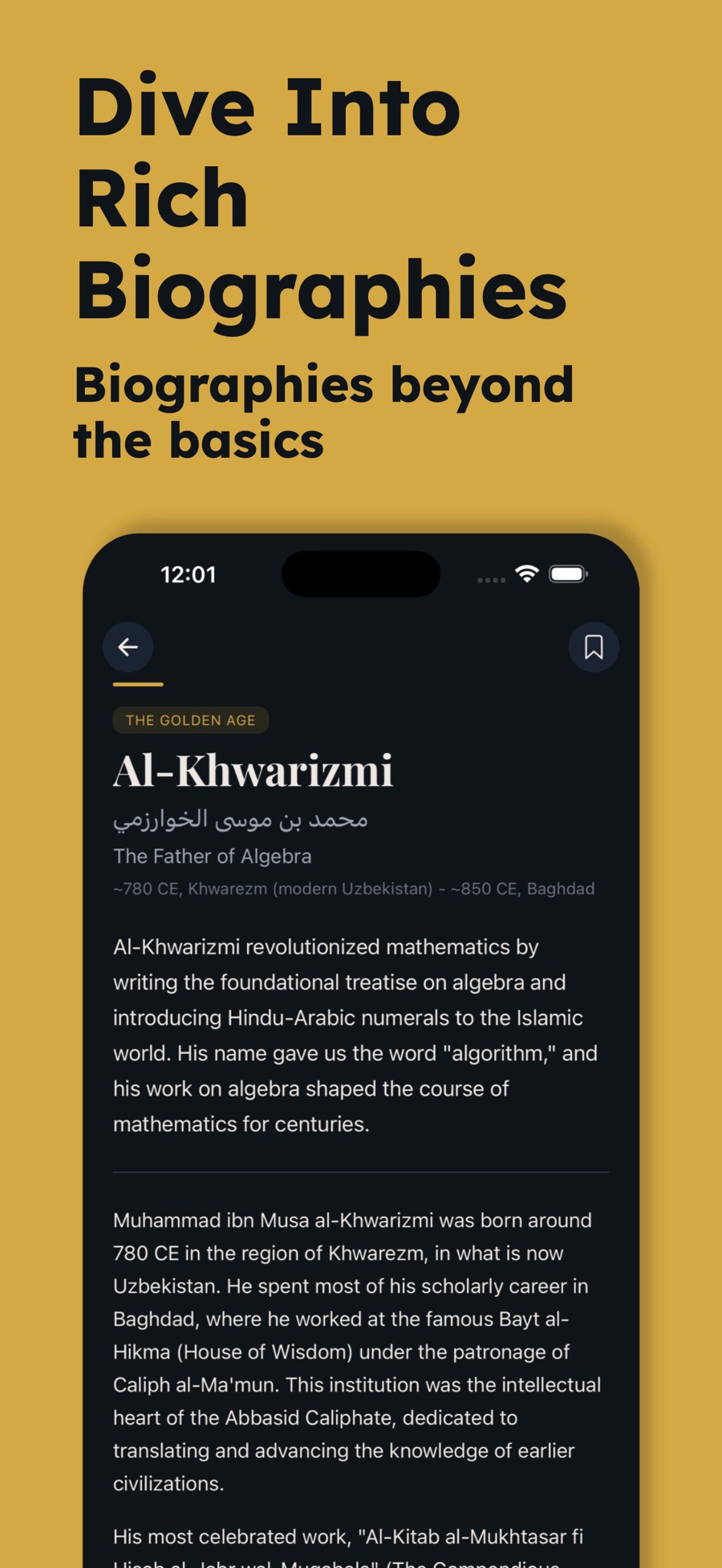
Each biography includes a concise summary, a deeper narrative read, key accomplishments, notable quotes, and academic source citations.
Historical eras
Browse by era — from the Golden Age of Science and Philosophy and Al-Andalus to the Ottoman Empire, the Mughal Empire, and Modern Reformers.
Curated collections
Themed starting points such as Architects of Discovery, Women Who Shaped History, The Travelers, Healers and Physicians, and The Mystics.
Historic cities
Explore figures through Baghdad, Cordoba, Damascus, Cairo, Istanbul, Samarkand, Timbuktu, and more — each city page shows every connected figure.
Relationship-first navigation
See who taught whom and who influenced whom through teacher–student, family, patron, and contemporary links across eras and regions.
Alias-aware search
Search "Averroes" to find Ibn Rushd, or "Saladin" to find Salahuddin al-Ayyubi. Handles kunya, Latin names, and common spellings.
Inside every biography
Legata is not a quiz app, not a social feed, and not an AI chatbot. It is a reference atlas designed for focused reading: serif headlines, clean sans-serif body text, and full dark and light mode support. No ads, no distractions, no interruptions.
Every figure — from Al-Khwarizmi and Omar Khayyam to Rumi and Mansa Musa — is presented with scholarly rigor and narrative depth, so a five-minute skim and an evening deep-read are both rewarding.
Twelve eras. Twenty-nine cities. One connected story.
History is easier to hold onto when it has a shape. Legata organizes its figures by the eras they defined and the cities that shaped them.
Browse by era
- Golden Age of Science & Philosophy
- Al-Andalus
- Crusades & Ayyubid Period
- Mamluk Sultanate
- The Seljuk World
- Ottoman Empire
- Mughal Empire
- Africa
- Cross-Era Thinkers & Poets
- Central Asia & the Timurids
- Southeast Asia
- Modern Reformers
Travel by city
- Baghdad
- Cordoba
- Damascus
- Cairo
- Istanbul
- Jerusalem
- Samarkand
- Granada
- Fez
- Bukhara
- Isfahan
- Delhi
- Timbuktu
- + 16 more
How Legata helps you
Curious readers
Start with a curated collection — The Travelers, The Mystics, Builders of Beauty — and let relationship links pull you deeper, one figure at a time.
Students & lifelong learners
Concise summaries give you the exam-ready version; deeper narrative reads and source citations give you material you can actually trust and follow up on.
Heritage explorers
Trace the scholars, poets, and rulers behind names you grew up hearing — with transliteration-friendly search that meets you at whatever spelling you know.
Travelers
Visiting Istanbul, Granada, or Fez? Open the city page and see every connected figure and the city's historical significance before you go.
Free to start
Explore your first three figures completely free — no account, no commitment. To unlock the full atlas of 150+ figures across all eras and collections, choose weekly, yearly, or one-time lifetime access. All subscription details are available within the app.
Frequently asked questions
Legata is free to download, and your first three figures are completely free to explore — no account, no commitment. To unlock the full atlas of 150+ figures across all eras and collections, you can choose weekly, yearly, or one-time lifetime access. Full subscription details are shown inside the app.
No. There is no account to create and no connection to external servers. Your bookmarks, reading history, and preferences stay on your device. The app also has no ads.
No. Legata is deliberately not a quiz app, not a social feed, and not an AI chatbot. It is a reference atlas built for calm, focused reading, with serif headlines, clean body text, and full dark and light mode support.
Legata spans over a thousand years across three continents, organized into 12 eras — including the Golden Age of Science and Philosophy, Al-Andalus, the Crusades and Ayyubid period, the Mamluk Sultanate, the Seljuk World, the Ottoman Empire, the Mughal Empire, Africa, Central Asia and the Timurids, Southeast Asia, Cross-Era Thinkers and Poets, and Modern Reformers.
Yes. Each figure includes a concise summary, a deeper narrative read, key accomplishments, notable quotes, and academic source citations.
Legata is currently available on the iOS App Store for iPhone and iPad, and requires iOS 15.1 or later. An Android version is not currently listed.
Legata's search is alias-aware. Search "Averroes" to find Ibn Rushd, or "Saladin" to find Salahuddin al-Ayyubi. It handles kunya, Latin names, and common transliteration variants.
Reading guides
Evergreen primers written for readers who want the story behind the names — and how a reference atlas fits into the picture.
- Scholars of the Islamic Golden Age The House of Wisdom, the translation movement, and the polymaths who changed science.
- From Baghdad to Timbuktu: Cities That Shaped History Why certain cities became engines of learning — and how to read history through place.
- Women Who Shaped History Rulers, scholars, and patrons the textbooks skim past — and how to find their stories.
- How to Learn History Through Biographies A practical method for turning names and dates into a connected mental map.